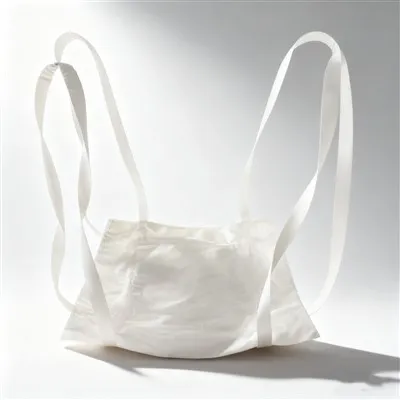
Pallet Sling Bag has no fixed service‑life value. Its longevity is primarily governed by four critical factors: material specifications, working conditions, load‑bearing ratings and maintenance routines. Under standard‑compliant operation and proper upkeep, conventional industrial‑grade products deliver a service life of 2‑5 years with 80‑150 reuse cycles. Heavy‑duty wear‑resistant models can exceed 5‑year lifespans, while low‑grade ordinary versions only last 6‑12 months. Its performance under different scenarios is detailed below.
Material specifications exert decisive influence over service life. High‑quality Pallet Sling Bag uses virgin thickened polypropylene woven fabric paired with high‑strength industrial‑polyester lifting straps. Dense warp‑and‑weft weaving delivers excellent wear resistance, tensile strength, anti‑aging performance, water resistance and anti‑corrosion properties. Multi‑layer reinforced stitching joins lifting straps to the main body to stop thread loosening and rupture, laying a solid foundation for long‑term deployment. Such heavy‑duty industrial‑grade products can operate for 3‑5 years with over 120 reuse cycles under indoor‑warehouse conditions and rated‑load operation. Low‑cost inferior Pallet Sling Bag uses recycled thin fabric with crude stitching on lifting straps and is prone to abrasion and tearing. It only fits short‑term one‑off or limited‑cycle usage, delivering a service life of merely 6‑12 months and fewer than 30 reuse cycles.
Working conditions create direct impacts on service life. Indoor, ambient‑temperature, dry and well‑ventilated warehouses represent optimal operating conditions. Without ultraviolet radiation, rainwater soaking or corrosive‑medium contact, material aging is suppressed and maximum service life can be realised. Long‑term open‑air exposure accelerates fabric ageing and embrittlement from ultraviolet rays. Fabrics gradually harden and crack, while lifting‑strap tensile strength declines. Service life drops by 40‑60 %, often limited to 1‑2 years. In chemical environments with strong acids, bases and high humidity, fabrics suffer progressive erosion, thread shedding and damage, which drastically shorten service life. Additionally, handling cargo with sharp edges such as crushed rock and metal scraps may tear fabric and create local damage that reduces overall service life.
Compliance with load‑bearing rules also carries significance. Each Pallet Sling Bag comes with a rated load capacity, commonly 1 ton, 1.5 tons or 2 tons. Strict adherence to rated‑load standards, without overloading, eccentric loading or concentrated point pressure, protects fabric and lifting‑strap structures and prolongs usable cycles. Sustained over‑weight haulage, offset hoisting and violent dragging will cause lifting‑strap deformation, fabric tearing and suture failure. A single violation may produce permanent damage and sharply reduce service life. Smooth hoisting and landing without impact or dropping also effectively lower wear‑and‑tear losses.
Storage and maintenance protocols cannot be overlooked. Clean dust and material residues off Pallet Sling Bag after use, to prevent corrosive leftover substances from eroding fabric. Fold it neatly during idle periods and store it in dry, shaded, well‑ventilated indoor locations to avoid damp‑induced mildew and sunlight‑driven ageing. Careless open‑air stacking exposed to rain, sunlight and compression causes damp mildew and accelerated fabric deterioration. Minor loose stitching and partial damage can be sewn and repaired for further reuse to raise overall usable cycles. In summary, high‑quality Pallet Sling Bag operated and maintained correctly acts as a cost‑effective reusable logistics consumable.

 English
- Português
- Deutsch
- Français
- русский
- Български
- Nederlands
- 日本語
- Türkçe
- O'zbek
- اردو
- Ελληνικά
- Català
- magyar
- Svenska
- Lietuvių
- Việt Nam
- 한국어
- Español
- Italiano
- عربي
- Čeština
- ไทย
- Eesti
- Gaeilgenah Éireann
- Bai Miaowen
- íslenska
- Cymraeg
- Polski
- hrvatski
- українська
- bosanski
- فارسی
- Latviešu
- עברית
- România limbi
- dansk
- Norsk
- suomi
- slovenčina
- slovenščina
- हिंदी
- Indonesia
- Melayu
- Malti
- Kreyòl Ayisyen
- বাংলা
- Srbija jezik (latinica)